

-
UX METHODOLOGIES
Honesty and transparency in all things
All of my research, work, and outputs are always immediately accessible to all of my stakeholder teams, along with meeting notes and meeting recordings. I have used a WIKI, or other team tools like Confluence to gather and organize these team assets. This transparency is incredibly useful to keep the team informed, as well as gaining trust equity with Stakeholders. This is also a useful technique to get new team members up and running quickly.
That being said, frequently we do not have time, resources, or access to employ all of our UX methodologies for every project. I employ those methods (or modifications thereof) where possible to obtain the necessary data for each project.
Below are some quick examples of UX methodologies I have used in-field:
1. Discover
2. Define
3. Create
-
Style guide
-
Mood board
-
Pattern Library
-
Mockups/Wireframes
Gap Analysis


Research Question
Why do internal users find it difficult to use our Product and Marketing tools to create Customer messages?
Why do internal users find it difficult to get an accurate and timely view into their budget availability?
Why do users have difficulty in finding quality content and curating it?
Problem Statement
WHO
Omni-channel Product and Marketing users
WHAT
need a way to easily; create, monitor, and manage, messages and campaigns, in multiple touchpoints and regions,
WHY
in order to ensure accurate, timely, and effective communication,
WOW
driving user-specific actions, engagement, and conversions, globally, increasing PayPal trust, brand, reputation (and revenue).
WHO
Google and Alphabet Business and Finance (~70k active users)
WHAT
need an on-demand, customizable, view into their budgets
WHY
in order to make immediate, accurate, and critical business decisions on spend within their organization and division,
WOW
at a glance, removing the chance for over/under-spend which could delay payments and affect brand perception and payee base.
WHO
Subject Matter Experts
WHAT
need a way to easily; locate review, and categorize data,
WHY
in order to ensure accurate, relevant, and current information is curated for Professionals,
WOW
so these professionals are provided current and relevant data in order to make critical decisions.
SWOT
I created 2 simple SWOT analyses, one for the project, 1 for the embedded apps integrated within.


Solution Hypothesis
Creating a unified suite platform approach will allow for standardization across ease of use, governance, and maintenance.
Create a customizable budgeting tool that allows immediate insights into all: spend, reserved, and operating expense dimensions.
Create a curation tool that allows SMEs to quickly identify relevant and current content for professionals.
Value Proposition
Company name
Project:
Company name
Project:
Company name
Project:
Value Proposition
Deliver the right message, to the right user, at the right time, on the right channel.
Key Performance Indicators
-
Time to create and deploy a message
-
Ability to see message performance data
-
Time to switch between modules in the platform.
-
Standardize budget repository: Unify budget-related metrics into one tool instead of 1-off spreadsheets
-
More efficient budget analyses: Reduce time on task from hours / days / weeks -----> minutes
-
Faster queries: Reduce latency for complex queries from >10 sec to <1 second
-
Time to gain critical mass of a curated collection
-
Reported quality of a collection


Design Scrum
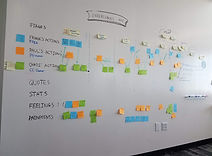
While at Google, We conducted a day-long design scrum with our expanded Stakeholder Team.
The design scrum activities included: user task identification, empathy analysis, pain point identification and categorization, flow definition, task and pain point prioritization, etc.


User Interviews / Testing
Informal and guerrilla
I led informal user review meetings a few times a week, engaging with users to validate elements, layout, and flows. I usually validated solutions with the user who originally logged the issue, and revalidated them with additional users. This model allowed a much quicker time to delivery and to implementation.
I found users were far more candid on a 1-to-1 session than in a formal test or group, though we did also run formal tests with individuals and groups.
Informal and highly iterative
I enlisted 8 internal users who would commit to weekly 30 minute sessions, for >5 months. This totaled to ~80 testing hours by Engineering handoff.
With these minute meetings, I was able to iteratively test, synthesize, and retest on nearly a daily basis, allowing for extreme velocity of design iteration.
PM as testing proxy
In most cases, I needed to gain user data through my Product Managers, based on access issues with Customers. This led to educating my PMs on UX interviewing techniques to gain non-fouled data.
This is my least favorite method, as I have no control over the environment and script deviations, but we do the best we can given how close we can get to our users.


User Personas / Archetypes
Based on velocity, I did very streamlined personas and evolved to combining with the PRD tasks, to maintain Sprint velocity and continuous development.


User Journey Map


I did an extensive journey map of the as-is environment to fully understand the convoluted process and when applications were engaged.
Task Analysis / Definition
For PayPal, I started with the PRD, and filled in the necessary steps from User Interviews


IBM
Project: Datacap


Empathy Map

When I first joined, I reviewed textual data of various user research decks and created a more visual display of the data to better understand the nature of the feedback, journeys, and pain points. (intentionally illegible)
Information Architecture
I did an extensive analysis of potential IA groupings to see what really made sense for the users.

