

-
CONFIGURETEK
At ConfigureTek, we implemented and customized ServiceNow enterprise Employee Service Portals and Workspaces for ServiceNow Partners and Customers.
-
THE SOLUTIONS
Georgia State University Employee Portal
ROLE
Sr UX UI Designer
-
UX UI
-
Research
-
Content
-
Strategy
-
QA/UAT Testing
-
Train-the-trainer
TIMELINE
4 months to GA
TEAM
-
Clients
-
Engineering
-
Product Owners
-
Project Managers
-
SCRUM Masters
-
Managers
FOCUS AREAS
-
Intuitive experiences
-
Task simplification
-
Adhere to templates/style guides and modify when necessary


>10k
USERS
TBD
EFFICIENCY GAIN
90%*
USER SATISFACTION
* Projected based on Stakeholder/SME feedback
Scroll to explore
- THE OVERALL PROBLEMS
Several contributing factors led to poor performance of their existing portal implementation:
-
stale data
-
low traffic
-
old templates
-
dated visuals
- THE CHALLENGES
Resources
Resources were extremely tight, one UX Designer and one Engineer. We didn't have much time or resources dedicated to custom features and template modifications.
Release schedules
We had 3 months to create a production-ready product, migrate data, and test in 2 environments.
Evaluations
Quickly and efficiently evaluate users, tasks, structure, and IA strategy.
Team Changeover after kickoff
Our main Client Stakeholder had to back out right after kickoff and pass to their second, who was not read-in in the initial planning phase.
I was brand new on the team as was my Engineering counterpart.
- THE GOAL
The goal was to lift and shift their current old experience into new ServiceNow templates. After inspection of their existing portal, I put forth the case that we needed to restructure their data in order to accommodate their future planned growth, and that they anticipated with the portal reboot.
Goals included:
-
Portal refresh to current templates
-
Drive user engagement
-
Scalable structure
- THE STRATEGY
Migrate and restructure the content of their current portal into the new ServiceNow Employee Services Portal templates (Yokahama) with as little customization as possible.
User research
I researched common user types and patterns of ServiceNow Employee Services users in universities, then matched with the GSU model.

Persona research
We identified 2 main focus personas (Faculty, Staff*) that perform the majority of the work within the portal, and broke out which main focus areas they worked in.
While the portal was meant to be self-service, we uncovered that users would frequently seek out a Faculty or Staff member to submit requests on their behalf.
*For the purposes of the redesign launch, we combined Staff and Student Workers together into one persona.


Restructure the information architecture
This was supposed to be a 'lift & shift' engagement, though I had to choose the most logical structure within the ServiceNow templates to migrate their data easily into the new structure with minimal customization.
Being that the original IA structure was flat with little to no additional data and instructions, and scalability would become problematic, the GSU Team will be populating their now dedicated category and topics pages with additional info for their users before push to production.

Wireframe brainstorming
We explored a few landing page options and 2ndary data pages based on a combination of Georgia Tech's site they liked, and GSU's web style guide. We decided to scrap these based on the customization labor involved.


Sample user flow mockups
To test the new flows, I needed to mock up (Figma) the 4 main tasks in the new environment. Given the way GSU implemented its data, the flows were very similar.

SItemap
A purview across the landscape of the initial implementation shows how we restructured the original flat architecture.

- THE FINAL PRODUCT
Landing (authenticated)
The header is slightly customized by adding the GSU logo to the traditional ServiceNow header.
Adding an engaging background image emotionally draws the user into the portal, creating a more immersive experience.
Landing Before
Landing After
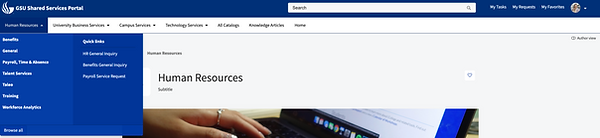
Information Architecture
We incorporated a new IA structure (modified mega-menu) to reveal categories, topics, and main quick links, accessible from all pages.
This restructure allowed for the expansion of each hierarchical menu item as they grow into the new structure, which was an original requirement.
IA Before: Tree (2ndary page only)
IA After: Menu (global header)
Footer
We added a reiteration of the website footer to keep those useful links and data always available, reinforcing a familiar landing.
Footer Before

Footer After

Category Page (net new)
We made minor modifications to the standard template.
-
We added a hero image on all the 4 initial main category pages.
-
We added a custom box under the topics for additional general information and contact info
-
We pulled a few key Quick Links for each category
-
We wrapped each portal page in the customized header and footer

Topic Page (net new)
Topic pages fall under each of the 4 main categories.
We made minor modifications to the standard template.
-
We added a custom box under the title for additional general information and contact info
-
We pulled key quick links for each topic
-
We wrapped each portal page in the customized header and footer

- THE OUTCOME
Well-received by Stakeholder Users
While it was a paradigm shift from their old model, the opportunity for scaled growth and expansion of the new model is far more logical. The timing to resurrect the old portal into something more vibrant and engaging was ripe with opportunity.
- LESSONS LEARNED
The other side of the equation